Check the buyer - send country, company number and cart total. A limit and terms come back in three seconds.
Pay-later for B2B checkouts
Pay-later that works for your buyers in six EU countries, not just France.
Termijn adds pay-later to your B2B checkout. A business buyer in Sweden, Denmark, Finland, Germany, the Netherlands or France gets 30, 60 or 90 days to pay. You are paid the next working day, and we carry the risk.
A sandbox key in the reply · no subscription
Defacto checks French company codes and French registers. A French buyer is approved in 27 seconds. A Swedish one can’t be.
A document model reads scanned filings from four of the six registers.
Objection 1 · credit checks
Can you really set limits from a company register?
Defacto reads the buyer’s bank account, 153 indicators, and answers in 27 seconds. You read a register and last year’s accounts. Won’t your limits be small, or wrong?
Smaller, yes. A model sets each limit from the odds of paying late.
But a buyer in the middle of an order won’t connect a bank account.
All six countries have a register that says who the buyer is. Nobody connects anything, and the answer takes three seconds.
- Six national company registers, read live
- Filed accounts: equity, turnover, short-term debts, the auditor’s opinion
- Your own order history with the buyer
Objection 2 · coverage
Six countries isn’t nine, and Mondu says thirty.
Mondu lists 30-plus European countries and Two lists 19. If the button shows for six of your nine markets, the checkout still looks broken on launch day.
Neither Mondu nor Two publishes a price, so the revenue-share line in your board deck stays blank either way.
A buyer in a covered country gets a limit or a clear reason. A buyer anywhere else never sees the button.
- Belgium, Austria, Poland, Spain: not covered, and no date yet
- Keep your manual net-terms process for those
Objection 3 · the one we can’t solve
Your German buyers’ procurement teams won’t accept Dutch law.
Every buyer in every country contracts with one lender, Termijn B.V., under Dutch law. Some German and French procurement teams will refuse that, and we lose those buyers.
With one lender you sign one agreement.
A lender with a different entity per country hands you six contracts.
We can’t turn a Dutch contract into a German one.
- One switch per country: Germany off, Sweden on
- Disputes go to Amsterdam, under Dutch law
How it works
Three API calls, one webhook, and a switch per country.
Nothing runs on your servers. The buyer accepts on a page we host, and order updates come back by webhook.
Six registers, read live and cached for a day.
Danish and Swedish accounts arrive as structured data. Finnish, French, Dutch and German ones are scans, read by a document model.
Create the financing - the buyer accepts the term, due date and charge on a hosted page.
Get paid - by the end of the next working day, in EUR, SEK or DKK.
Credit notes - one call reduces or cancels a financing.
Webhook - tells your endpoint or an Azure Event Grid topic when an order is approved, funded, paid or overdue.
Countries - one switch each. Launch six, pull one.
The decision engine
Limits come from filings and your history. A no never comes from a model.
A document model reads the filings; a classifier turns the figures into the odds of ninety days overdue.
Filed accounts - scans, PDFs or web pages, read for equity, turnover, short-term debts and the auditor’s opinion
Automatic no - only from the register, for dissolved or insolvent companies
No terms at the cart - for sole traders, companies under a year old, cases below the threshold, any filed figure under 0.85 confidence
Next working day - an Amsterdam underwriter decides, and writes down why
Public pricing
€0.70 per €1,000 deferred, per day. A quarter of it is yours.
Inside Termijn
What your buyer sees, what you see, and why a limit is what it is.
A Swedish checkout with pay-later on, the reasons behind one limit, and the payment schedule for that order.
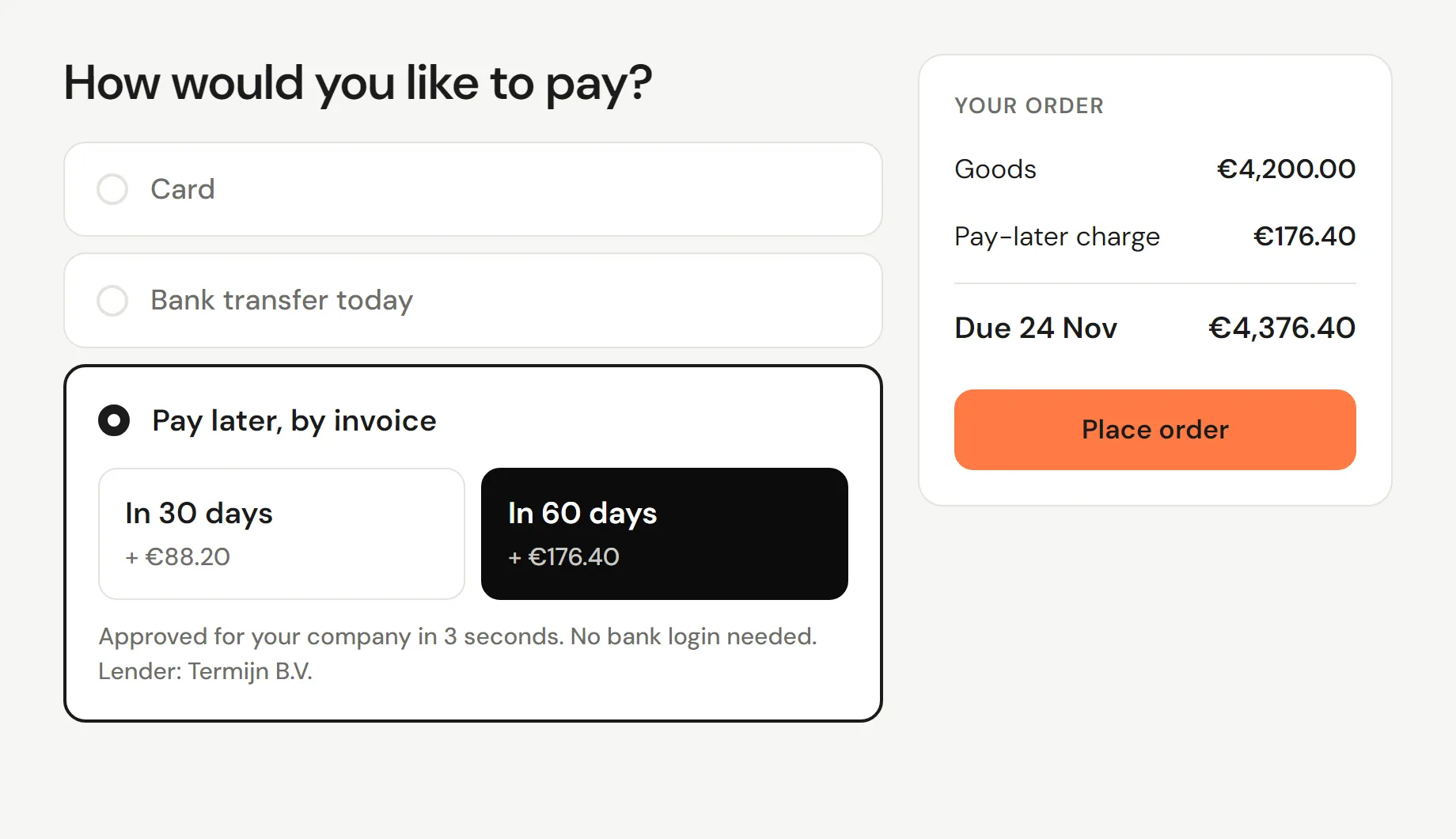
Your checkout, with pay-later on for a Swedish buyer
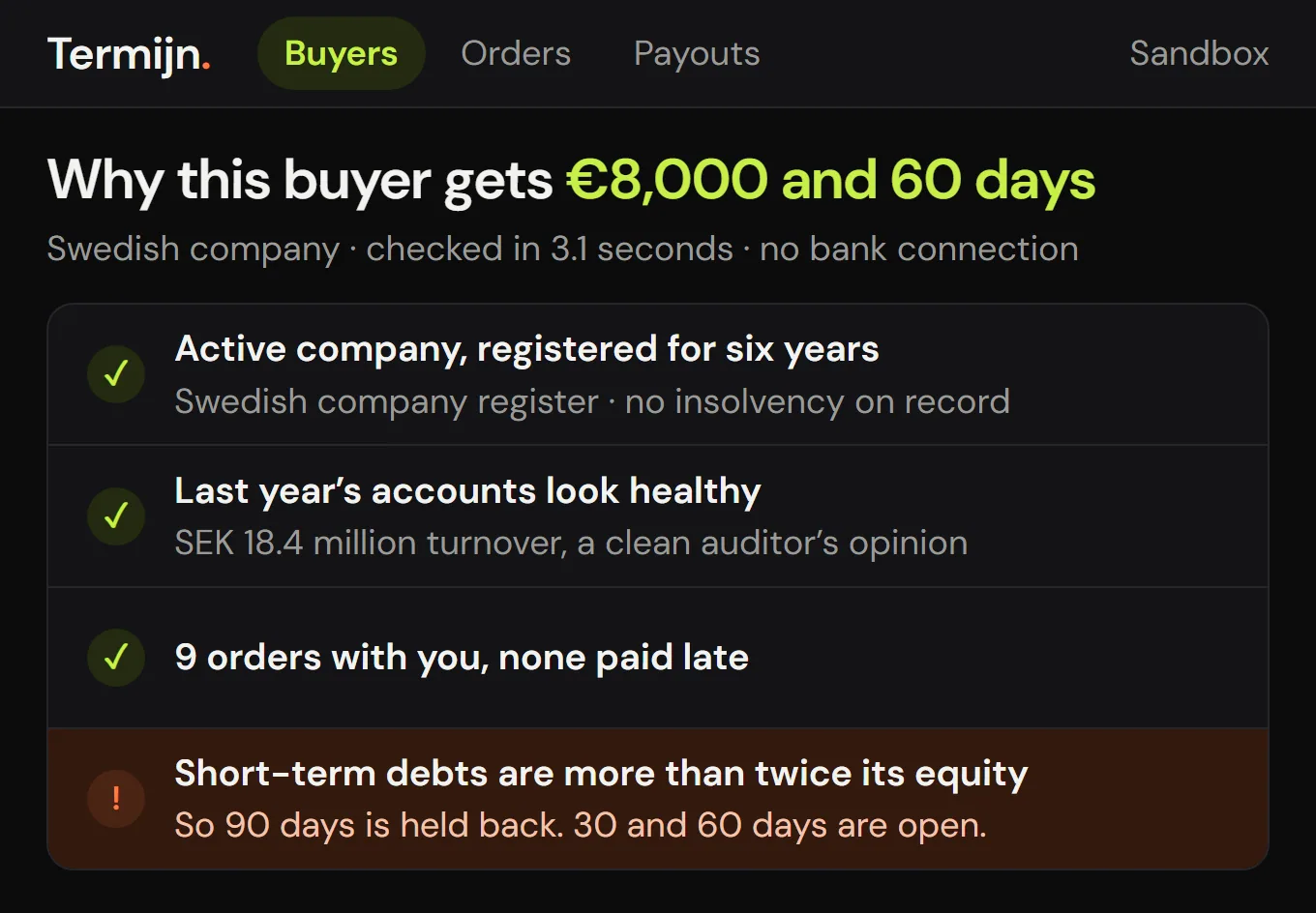
Why this buyer gets €8,000 and sixty days, in plain words
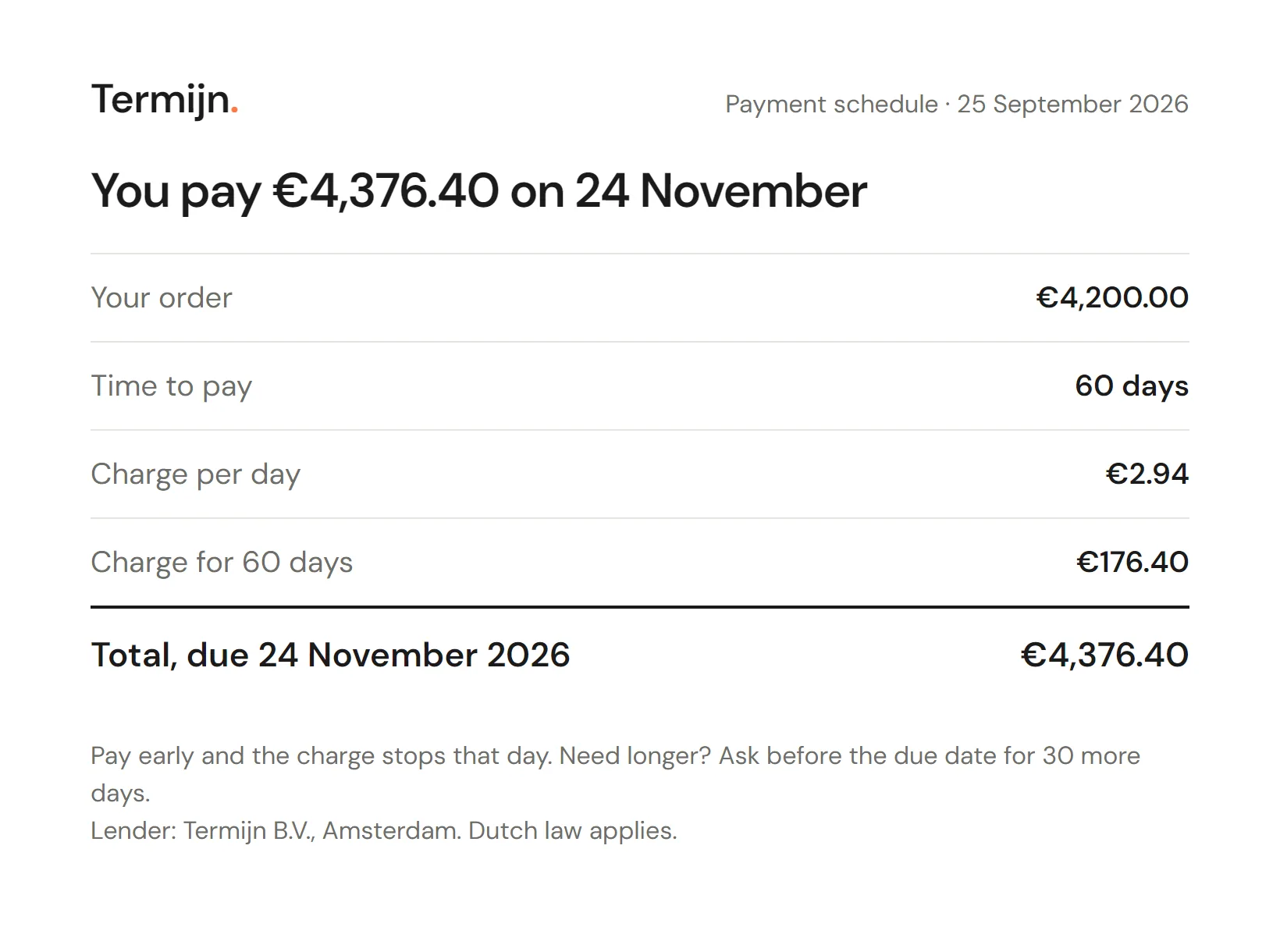
The payment schedule your buyer’s finance team files
The reasons screen shows which register answered and which accounts were read.
The schedule is a document, because the buyer’s finance team files it.
Our engine reads the register and the filed accounts, not the buyer’s bank, so our limits are lower. But every registered buyer in six countries gets one at checkout, without connecting anything.
Renata Culbertson, CRO, Termijn
FAQ
Where 0.07% a day comes from, and who collects when a buyer pays late.
- Why this price?
- Defacto quotes 0.05 to 0.08% a day. €0.70 per €1,000 is 0.07%, so you never trade coverage against rate.
- How long does a decision take?
- Three seconds, or ten when the accounts are a scan.
- What if the buyer pays early?
- The charge stops that day.
- Who collects when a buyer pays late?
- The platform, by SEPA direct debit or transfer, through a collection partner in each country.
- Why not keep offering net terms ourselves?
- Intrum’s 2026 report: a 20-day B2B payment gap and 12% of revenue paid late, on your balance sheet.
- Why do German buyers enter a company number?
- A German VAT ID doesn’t lead to a Handelsregister number, so the checkout widget asks for it.
Registered companies in six countries
Orders at your checkout, financed at our risk.
A lender that reads bank data will give a French company a bigger limit.
- in scope01Registered companies only, active and not insolvent. Under twelve months on the register, an underwriter decides.
- we don't01No bank data and no invoice financing. A French company that wants its invoices financed should use Defacto.
- in scope02We take the credit risk, and the platform runs collection. You are paid whether or not the buyer ever pays.
- we don't02No installments, no card, no revolving credit. One payment per order, due in full, extendable once.
- in scope03Orders from €250. Smaller orders aren’t offered terms.
- we don't03No buyers outside the six countries. Belgium, Austria and Poland aren’t covered.
Thesis
The decision engine reads the register, the accounts and your order history.
The register says who the buyer is and whether it can borrow, the accounts roughly how much, and your history whether it pays.
A German GmbH with no accounts filed yet also goes to the Amsterdam underwriter.
Your sandbox key comes in our reply.
If you want a call, it is twenty minutes on where your buyers are, after you have the key.
We reply within one business day.
- ✓ All six registers work in the sandbox, no agreement needed
- ✓ Send your buyer list, get a limit or reason for each
- ✓ Live keys within five working days of complete paperwork